
Customer relationship management (CRM) is the backbone of every sales and marketing operation — but without automation, it can quickly become a time sink and even allow key opportunities to fall through the cracks.

Using a CRM with automation not only brings efficiency, consistency, and intelligence to everyday customer interactions, but it also helps keep teams aligned by handling repetitive tasks, syncing data, and increasing visibility into workflows.
In this article, we’ll go over why you should choose a unified CRM with automation instead of separate tools, what features to look for in a CRM automation tool, and the best automated CRM platforms in 2025.
Table of Contents
- What is a CRM automation tool and why does it matter?
- Why unified CRM automation software beats stitched-together tools
- What to look for in a CRM automation tool
- The best CRM tools with automation: Our top picks
- Three CRM automation workflows that drive revenue
- Frequently Asked Questions About CRM Automation
What is a CRM automation tool and why does it matter?
A CRM with automation combines customer relationship management software with automated workflows that handle repetitive sales, marketing, and customer service tasks without manual intervention. CRM automation tools are built into or connected to your platform to streamline tasks like data entry, lead nurturing, and reporting.
Instead of manually entering contacts, sending follow-up emails, or updating deal stages, automation tools do these jobs for you — freeing up time for sales and marketing teams to focus on building relationships and closing deals.
When teams rely on manual processes, critical data and tasks slip through the cracks. Sales reps waste time copying data between spreadsheets, emails, and apps. Marketing and sales might use different tools that don’t “talk” to each other, leading to duplicated work and inconsistent customer experiences. It becomes hard to see the full picture of your pipeline or track how leads are progressing.
In contrast, a unified, AI-supported CRM automates data syncing, lead follow-up, and customer insights in one place. Sales automation ensures no lead gets forgotten, communication stays consistent, and your team always has up-to-date information. The result is smoother collaboration, faster responses, and a more personalized experience for every customer.
Why unified CRM automation software beats stitched-together tools
Unified CRM automation software consolidates customer data, workflows, and analytics into one connected system, eliminating the inefficiencies that arise from managing multiple disconnected tools. Many teams start small, using separate tools for email, contact management, sales tracking, and reporting. But as the business scales, this “patchwork” approach quickly creates friction.
CRMs with automation streamline marketing, sales, and service workflows and eliminates these issues by bringing all of your customer data, workflows, and analytics into one connected system.
Mircea Dima, founder and CEO of AlgoCademy, emphasizes the positive outcomes of using a unified CRM platform over various stand-alone systems.
“Using a unified CRM system results in much less context switching, synchronization problems, reporting issues, and consequent focus shifting to other activities, allowing the team to focus on selling,” he says. “Disparate tools create invisible inefficiencies which compound over time.”
Below are a few specific ways that unified CRM integration and automation software addresses the issues often experienced when using stitched-together tools.
Data silos are eliminated
When data lives across multiple tools, it’s hard to get a complete view of each customer. One system might show recent emails, while another holds purchase history. A unified CRM platform prevents data silos and keeps everything in sync — contact details, interactions, and deal activity — so your team always has accurate, real-time information in one place.
Consistent segments and targeting
Fragmented systems often create inconsistent segments because each tool uses slightly different data. This leads to mismatched messaging and missed opportunities. In a unified CRM, segmentation happens automatically and consistently. Everyone — from sales to marketing — works from the same customer insights and audience lists.
Chris Sorensen, CEO of ARMOR Dial and PhoneBurner, points out that a unified platform can actually help humanize your team’s targeting efforts.
“The beautiful thing about a unified platform is that automation stops feeling robotic and starts feeling personal,” he says. “Smart CRMs should surface context in real time. Data like call history or engagement sentiment allow reps to tailor every conversation more naturally and targeted rather than just logging it.”
Fewer brittle integrations
When you connect multiple apps manually, every update or API change risks breaking something. These brittle integrations can cause sync errors or lost data. A unified CRM removes that risk by keeping all key tools under one roof, with native automation and reliable data flow between features.
Improved reporting
Pulling reports from multiple sources takes time and often produces conflicting numbers. Unified CRM software centralizes analytics, so your reports are based on a single, trustworthy dataset. Leaders can easily track performance, forecast revenue, and make data-driven decisions with confidence.
Lower maintenance and aosts
Managing a collection of disconnected tools means juggling multiple logins, updates, and subscription fees. A unified CRM with automation platform simplifies tech management, reduces costs, and saves your team hours of troubleshooting and manual syncing.
What to look for in a CRM automation tool
The best CRM automation tools provide essential capabilities that eliminate manual tasks, improve conversion rates, and create better customer experiences. These features work together to automate repetitive workflows while surfacing insights that help teams prioritize high-value activities and close deals faster.
“The best CRMs combine AI-powered lead scoring, automation of workflow, and dashboards with real-time analytics,” says Dima. “Integrations with marketing, billing, and customer service systems are vital, too. A CRM should not merely be a gathering of your sales process — it should also be brainpowering with your organization to generate accelerated growth.”
Use this checklist to evaluate the must-have features of a modern CRM automation tool:
1. Unified contacts and companies
Your CRM should act as a single source of truth for all customer data. That means every contact, company, and deal record lives in one place — automatically updated across sales, marketing, and service. No duplicate records or missing context.
2. Lead scoring
Automated lead scoring helps teams focus on the right prospects. The CRM should use behavioral and demographic data (and ideally AI) to rank leads based on their likelihood to convert, so sales reps always know where to spend their time.
3. Lead routing
When a new lead enters your system, it should be instantly assigned to the right person or team based on rules you define, such as territory, product interest, or deal size. This ensures no lead slips through the cracks and response times stay fast.
4. Sequences and workflows
Look for tools that automate follow-ups and internal processes. Sequences can trigger personalized emails or tasks based on customer behavior, while workflows can update records, assign tasks, or move deals through the pipeline automatically.
5. Customer journeys
Modern CRM automation goes beyond sales to map out the entire customer journey. This feature helps you orchestrate multi-step campaigns, monitor engagement, and nurture leads with relevant content at each stage of the funnel.
6. Ticketing and service automation
For post-sale support, integrated ticketing ensures that customer issues are tracked and resolved quickly. Automated ticket routing, status updates, and SLA reminders help service teams deliver a consistent, high-quality experience.
7. Reporting and analytics
Robust, unified reporting gives you full visibility into pipeline performance, conversion rates, and customer satisfaction. The best systems let you build dashboards that combine data from sales, marketing, and service — no spreadsheets required.
8. AI assistance
AI can handle tedious data entry, recommend next actions, and surface insights you might miss. Look for AI tools that assist with forecasting, content creation, and lead qualification — helping your team work smarter, not harder.
“The best CRM automation tools properly combine intelligence with transparency,” says Sorensen. “They make it easier for teams to trust the system and see what‘s working, what’s not working, and then adjust much quicker.”
9. Governance and data quality
A strong CRM automation platform should include built-in controls to maintain clean data, manage user permissions, and ensure compliance with privacy regulations like GDPR. Reliable governance keeps your CRM accurate and secure as you scale.
10. Extensibility and integrations
Finally, your CRM should grow with you. Choose a platform with open APIs and an app marketplace so you can integrate additional tools as needed — from marketing automation to accounting systems — without breaking your workflows.
The best CRM tools with automation: Our top picks
The best CRM tools with automation combine unified customer data, intelligent workflows, and AI-powered insights to eliminate manual tasks and improve team productivity. Whether you’re looking for an all‑in‑one CRM or a specialized tool for SMB, mid-size startup, or enterprise, these are the best CRM tools with automation we recommend exploring.
1. HubSpot CRM
Best for: With excellent native coverage and built-in automation for sales, marketing, and service, HubSpot’s unified CRM is ideal for SMBs scaling toward enterprise.
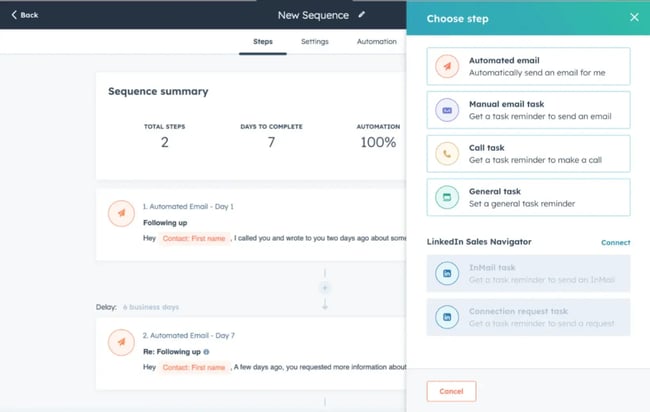
For sales and marketing teams, the challenge isn’t just collecting data — it’s connecting it. HubSpot’s Smart CRM and its suite of integrated hubs solve this problem by uniting every part of your customer experience under one automated, AI-powered platform. HubSpot Smart CRM unifies customer data across teams, underpinning marketing, sales, and service hubs so you’re working from one “source of truth.”
One of those integrated hubs is Sales Hub, which gives sales teams the tools to automate prospecting, follow-ups, and deal management — all within the same CRM. Reps can enroll contacts in personalized sequences, trigger tasks based on activity, and track engagement automatically. The CRM also has a built-in AI. Breeze Copilot generates AI-powered next best actions and also helps craft emails, log calls, and prioritize leads most likely to convert.
The benefits of Sales Hub are compounded when used in combination with HubSpot’s Marketing Hub, which centralizes lead generation, email marketing, campaign management, and analytics in one system. You can automate entire customer journeys — from first touch to sales-ready handoff — and use AI to personalize messages based on behavior or lifecycle stage.
What I like: HubSpot is free to get started and scales as you grow. It’s best for small businesses looking for a platform that grows with the business and uses strong native modules — rather than stitching many apps together.
Pricing: Free forever tier; paid plans start at $9/month per seat.
2. Salesforce
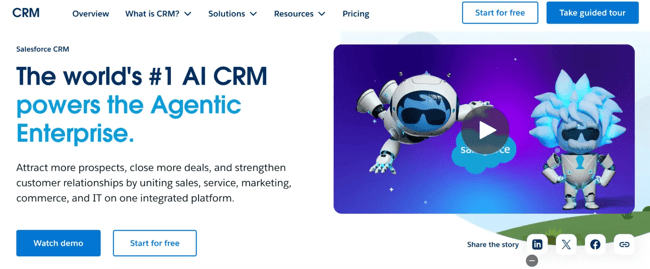
Best for: Midsize to large companies with complex processes that need robust customization, lots of integrations, or to operate at scale.
Salesforce CRM offers an enterprise-grade infrastructure and an extensive app ecosystem, making it ideal for large companies that need heavy customization and integrations.
While Salesforce offers a wide suite of cloud tools — Sales Cloud, Service Cloud, and Marketing Cloud — with deep extensibility and AI capabilities, the trade-offs are more complexity, higher cost, and longer implementation time than lighter CRMs.
Pricing: Salesforce’s Starter Suite starts at $25/month. It also offers a 30-day free trial.
3. Zoho CRM
Best for: You have moderate automation needs, and don’t need the absolute top-tier enterprise feature set.
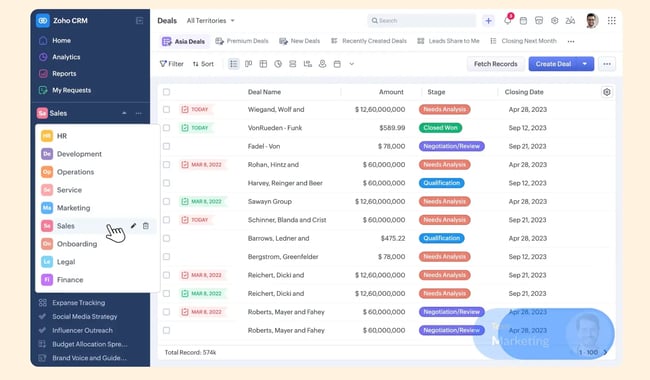
Zoho CRM is a cost-effective and full-featured CRM, making it a strong choice for SMBs or mid-market companies that want decent automation without an enterprise budget.
Features include lead and deal management, sales automation, and advanced workflows. Higher tiers also include access to Zoho’s AI assistant, “Zia,” which offers sales assistance for tasks around content creation, predictive analytics, and forecasting.
Pricing: Offers a 15-day free trial as well as a free plan with limited features for up to 3 users; paid plans start at $14/month.
4. Pipedrive
Best for: Teams looking for effective sales pipeline management, and don’t yet need heavy marketing and service automation.
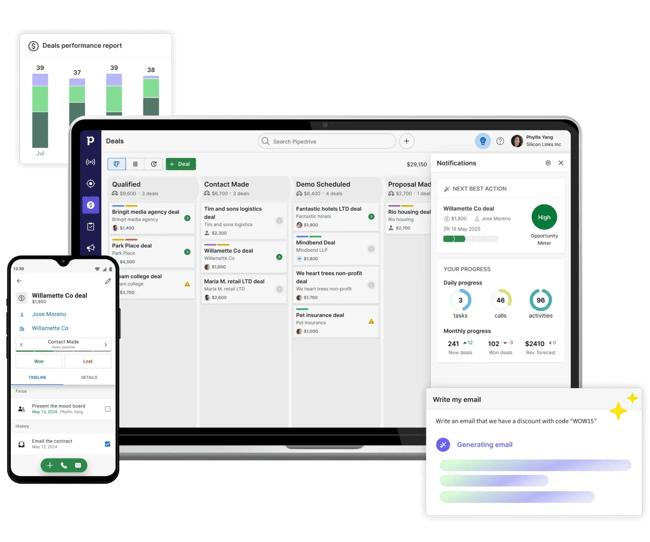
Pipedrive is a sales-centric CRM with a focus on activity-based selling, pipeline management, fetching leads, and routing.
This can be a useful platform for SMBs looking to optimize pipeline and deals without overwhelming service and marketing complexity. However, with lighter marketing and service coverage compared to more unified CRMs, sales teams may need add-ons for complete lifecycle automation.
Pricing: Offers a 14-day free trial; paid plans start at $14/month.
5. Freshsales by Freshworks
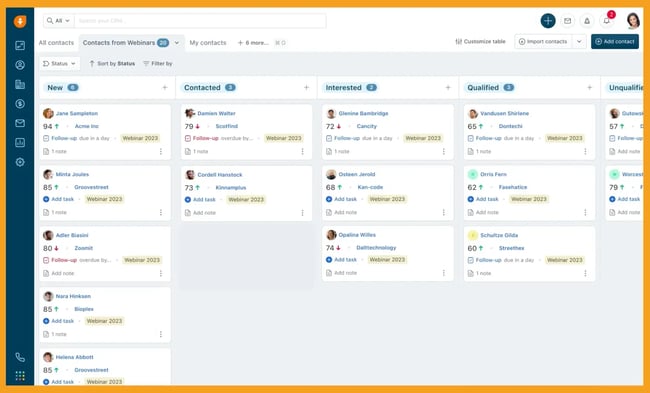
Best for: Mid-sized businesses or startups that need solid CRM automation with a unified view, but want to keep costs down.
Freshsales is a cost-effective CRM with good automation capabilities and AI features, suitable for small to midsize teams that want reliable capability without enterprise pricing.
Built to unify sales and marketing context in a single customer view — using kanban boards with drag-and-drop functionality — the platform supports AI, sequences, and workflows. However, it may not have the same breadth or polish as larger CRM platforms, and some features are locked behind higher tiers.
Pricing: Offers a 21-day free trial; paid plans start at $9/month.
Three CRM automation workflows that drive revenue
CRM automation workflows drive revenue by automatically moving leads, customers, and service tickets through the pipeline, ensuring no opportunity is missed. Instead of relying on manual follow-ups and spreadsheet reminders, automated workflows trigger the right action at the right time based on customer behavior and lifecycle stage.
Here are three core workflow automations that directly support growth and retention, plus tips on how to build each one in HubSpot.
1. Marketing-to-sales handoff and lead routing
This workflow bridges the gap between marketing and sales by automatically qualifying, scoring, and assigning leads. Instead of manually reviewing spreadsheets, high-intent leads are instantly routed to the right rep with all the necessary context attached — ensuring fast follow-up and better conversion rates.
This workflow starts when marketing captures a lead from a form, ad, or event. Next, the lead scoring automation evaluates engagement, which includes opens, clicks, site visits, or any other engagement metric you’re tracking.
Once a score threshold is met, the lead is marked as “sales-ready.” Routing rules assign it to the right rep based on region, product line, or availability. A follow-up sequence or task is triggered automatically.
Build this in HubSpot:
- Use Lead Scoring to assign points based on engagement or firmographics.
- Create a Workflow that enrolls leads once they reach a specific score.
- Add Lead Assignment Rules to route leads by owner or team.
- Trigger a Sales Sequence to send outreach emails or create a task reminder for the rep.
2. Service and success automation
Automated service workflows enable teams to respond quickly, resolve issues efficiently, and identify potential upsell opportunities. When customers get consistent, timely support, retention improves — and satisfied customers are more likely to expand their business.
This workflow automation is triggered when a support ticket or service request is submitted. The CRM automatically creates and categorizes the ticket.
Then, based on the issue type or priority, it’s routed to the right agent or team. If a resolution takes longer than expected, escalation workflows notify managers. Once resolved, a follow-up email requests feedback or triggers a success check-in.
Build this in HubSpot:
- Use Ticketing Pipelines in the Service Hub to track stages like “New,” “In Progress,” and “Resolved.”
- Set up Automation Rules to assign tickets by priority or product line.
- Add SLAs and escalation triggers to ensure quick responses.
- Use Customer Feedback Surveys and Automated Follow-ups to measure satisfaction and maintain relationships.
3. Content‑driven nurture with personalization
This workflow keeps leads engaged over time with relevant, personalized content, building trust and warming prospects until they’re ready to make a purchase. Automated nurture sequences combine behavioral triggers, segmentation, and AI personalization to deliver the right message at the right time.
To create this workflow, start by segmenting leads based on attributes such as role, industry, or stage in the buyer’s journey. Each segment then receives tailored content (e.g., blog posts, case studies, or webinars).
Engagement, including opens, clicks, and downloads, automatically adjusts future emails or sequences. High-intent actions — such as visiting a pricing page — trigger alerts or handoff to sales.
Build this in HubSpot:
- Create Smart Lists that segment contacts dynamically by specific criteria (e.g., lifecycle stage or engagement level).
- Use Workflows to send timed, personalized email sequences.
- Incorporate Dynamic Content and Personalization Tokens to tailor messaging.
- Set up Behavioral Triggers to notify sales or move contacts to “Sales Qualified Lead” status.
Frequently Asked Questions About CRM Automation
Do I need marketing automation if my CRM has workflows?
Not always. Many unified CRMs, like HubSpot, include marketing automation natively, eliminating the need for separate tools. If your CRM can handle email sequences, lead nurturing, segmentation, and campaign tracking, you may not need a separate tool.
How do I migrate from a stitched stack without losing data?
Migration starts with mapping the current data you already have. Export contact, company, deal, and activity data from each tool, then audit it for duplicates and inconsistencies. Next, define how that data should look in your new CRM — what fields to keep, merge, or retire.
Use your CRM’s import tools or migration partners (HubSpot, for example, offers guided imports and API-based migration help). Always test with a small batch first, verify the results, then migrate in stages. Keeping a backup of your original data ensures nothing gets lost.
What are the best ways to measure automation success?
Measure automation success by tracking business outcomes rather than activity metrics. Metrics such as lead response time, conversion rate, and pipeline velocity demonstrate the impact of automation on revenue. You can also monitor customer satisfaction scores (CSAT/NPS) and ticket resolution time to gauge post-sale efficiency.
For marketing workflows, consider engagement metrics — such as opens, clicks, and content interactions — alongside influenced revenue. The ultimate measure of success is when your team spends less time on admin work and more time closing deals or supporting customers.
How do I keep automations from breaking as my stack grows?
Automations fail when dependencies change — like form fields being renamed or integrations being updated. To prevent this:
- Document your workflows and owners.
- Use naming conventions for triggers and fields.
- Review automations quarterly to ensure they still align with business goals.
- Centralize key processes in your CRM instead of relying on external connectors. If you’re in HubSpot, tools like Workflow History and Data Quality Command Center make it easier to spot and fix broken automations before they cause issues.
Can I start small without rebuilding my stack?
Absolutely. Start with one or two high-impact workflows — like lead routing or automated follow-ups — and expand gradually. Most CRMs, including HubSpot’s Smart CRM, enable you to layer automation on top of your existing data and integrations.
As you scale, you can bring additional functions (like marketing, service, or analytics) into the same ecosystem. The goal isn’t to rebuild everything at once — it’s to unify gradually while keeping your processes clean, connected, and easy to manage.
Build Smarter Workflows With CRM Automation Tools
CRM automation isn’t just about efficiency — it’s about creating a connected customer experience that drives predictable growth. The more your tools, teams, and data work together, the easier it becomes to scale revenue and deliver personalized value at every stage.
The best CRM automation tools connect marketing, sales, and service tools, offer precise targeting and segmenting workflows, and are backed by smart insights through AI assistance.
If you’re ready to simplify your tech stack and bring marketing, sales, and service under one roof, HubSpot’s Smart CRM is a great place to start. You can explore its automation tools for free, build a few key workflows, and scale as your needs grow.
