
Customer service is the backbone of every successful business. Providing exceptional customer service isn’t possible without equipping your team with the right tools.
Customer success teams strive to keep customers satisfied. A customer service tracking software helps in improving customer satisfaction by centralizing interactions and providing actionable insights to improve response times.
This post will explore the top customer service tracking software for 2026, including key features, pricing, implementation tips, and strategies to maximize ROI.
Table of Contents
- What is customer service tracking software?
- Who should use customer service tracking software?
- Customer Service Tracking Software Features
- Best Customer Service Tracking Software
- Frequently Asked Questions About Customer Service Tracking Software
What is customer service tracking software?
Customer service tracking software is a system that helps businesses manage and monitor all customer interactions in one place. Customer service tracking software unifies ticketing, omnichannel communication, SLAs, analytics, and AI assistance. Instead of dealing with scattered emails, phone calls, or chats, it brings everything together through a unified ticketing system. Simply put, every customer request becomes a “ticket” that teams can track.
All good issue tracking software support omnichannel communication. Customers can reach out through email, chat, social media, or phone. Efficient customer tracking involves recording all conversations in one view. No request should be lost, and agents should be able to see the full history of each customer interaction.
Customer service tracking tools also help teams stay on top of service level agreements (SLAs) by automatically tracking response and resolution times. Built-in analytics tools provide insights into key metrics like ticket volume, resolution rates, and customer satisfaction.
With AI assistance, the system can automatically route tickets to the right agent, suggest replies, or even resolve common issues on its own.
Customer service tracking software solves major pain points like fragmented communication, slow ticket routing, lack of visibility, heavy manual work, and poor reporting. It makes the support experience faster, more connected, and data-driven.
Who should use customer service tracking software?
Customer service tracking software is essential for teams managing large volumes of support inquiries, juggling multiple channels, or struggling with visibility and follow-ups. It’s especially valuable for ecommerce, ITSM, RevOps, and support leaders who want better efficiency, happier customers, and measurable ROI.
Support leaders know that it’s time to invest in a customer tracking platform when agents are overworked, complaints are rising, and customer satisfaction starts to drop. The best way is to observe or ask your team if they are overwhelmed by inquiries or often miss follow-ups. Gauge if your team struggles to track tickets across channels like email, chat, and phone.
Ecommerce customer service teams can benefit greatly from customer tracking platforms to manage large volumes of inquiries, streamline order-related communication, and provide faster, more consistent support.
Similarly, RevOps teams can benefit from customer service tracking software that aligns sales and support data. The aim here is to keep track of how customers interact with your business and find ways to help them stay longer and buy more.
Customer Service Tracking Software Features
A robust customer service tracking platform is one where every customer inquiry is logged, tracked, and resolved efficiently. It combines ticket management and omnichannel support to give agents a complete view of each interaction.
Here is a list of must-have features and nice-to-have features for any reliable customer service tracking software.
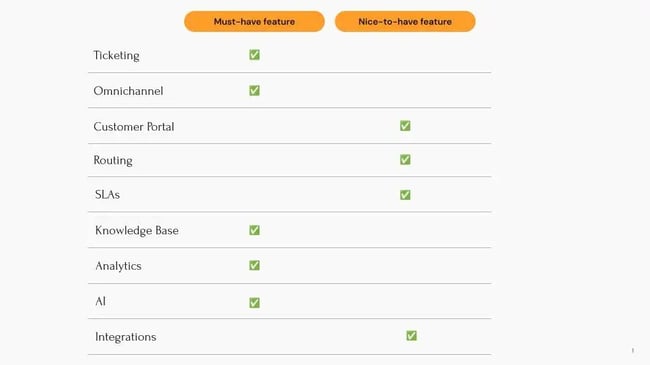
The features marked as must-haves are backed by data. According to the latest State of Customer Service report, 86% of CRM leaders are of the opinion that AI is useful in making customer interactions feel more personalized. So, AI capabilities are a must-have.
Let’s look at a brief description of each feature:
- Ticketing. A ticketing system helps in logging the communication between the customer and reps into one continuous thread.
- Omnichannel. Support across multiple channels allows teams to meet customers where they’re at, whether it’s chat, phone, email, WhatsApp, or SMS.
- Customer portal. This provides a place for customers to log in and view their open tickets, access account information, etc.
- Routing. This process assigns incoming customer support tickets to the most suitable support agent for resolving the problem.
- Knowledge base. A wiki or knowledge base acts as a centralized repository that customers can use to get answers to the most commonly asked questions. AI also makes use of the knowledge base to give a comprehensive answer to customers.
- Analytics. A unified data model enables accurate reporting and customer retention tracking.
- AI. AI-powered service operations improve agent productivity and response quality. With proper setup and review, AI strengthens quality by providing consistent, data-backed support to customer support representatives.
- Integrations, which collaborate with other everyday use software to make work easier. Common integrations include Google Workspace, Microsoft Teams, Slack, etc.
There are many more features, but these are the main ones. They give your team the structure, speed, and insights needed to provide reliable, high-quality support.
Pro tip: Looking for internal help desk software? Check out the top options here.
Best Customer Service Tracking Software
The best customer service tracking software combines unified ticketing, automation, analytics, and AI assistance to help teams respond faster and deliver better customer experiences. Below is a curated list of top platforms that stand out in 2026 for maximizing ROI and keeping customers happier for the long run.
1. HubSpot Service Hub
G2 Review: 4.4 (2,500+ reviews)
HubSpot’s Service Hub is a unified platform that brings together all your support channels, ticketing workflows, analytics, and CRM connections into one consistent experience. Here’s how it delivers value.
Omnichannel Communication
HubSpot lets you manage email, live chat, Facebook Messenger, WhatsApp, and phone conversations in one place. All interactions are tied to the same contact record, so every reply feels personal and informed. This creates a smooth, consistent support experience across every channel.
Automated Customer Service
Building automations and workflows makes it easy to route tickets to the right specialists quickly.
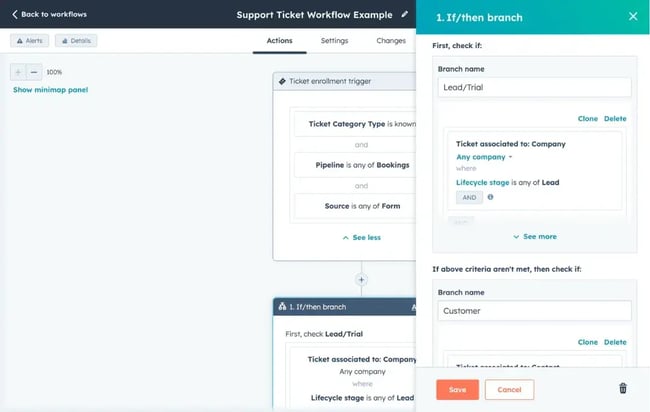
As a company grows, service interactions become more specialized, so directing specific types of issues to the right teams becomes even more important.
Conversation Intelligence
Conversation intelligence provides data-driven insights from customer calls. It gives an overview of customer interactions inside HubSpot, which helps close deals better. Essentially, this feature tracks talk-to-listen ratios, detects keywords and topics, and improves messaging.
Service Analytics Suite
Service analytics suite provides all analytics tools in one place. It encompasses forecasting, data, and reporting to track the success of customer service teams.
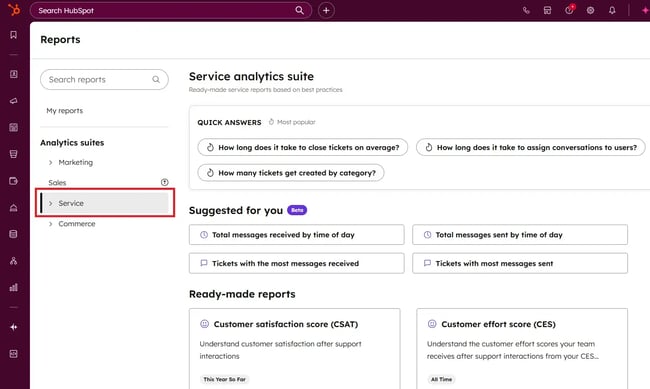
The interface is straightforward and gives an option of using ready-made reports to monitor key metrics such as customer satisfaction scores, customer effort score, and average ticket response time. Service analytics track SLA compliance, backlog, agent performance, and customer satisfaction. Pre-built reports can, of course, be fully customized to fit your team’s needs.
Customized Branding and Navigation
HubSpot makes it easy to manage your brand within the portal.
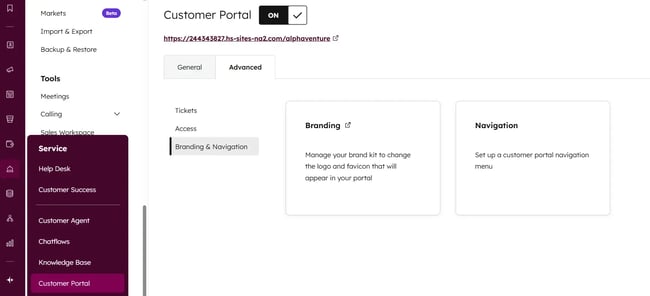
Update your logo, favicon, and other brand elements, and create a tailored navigation menu for a fully branded experience.
Skill-Based Routing
Skill-based routing automates the ticket creation process by assigning tickets to agents according to their skill set.
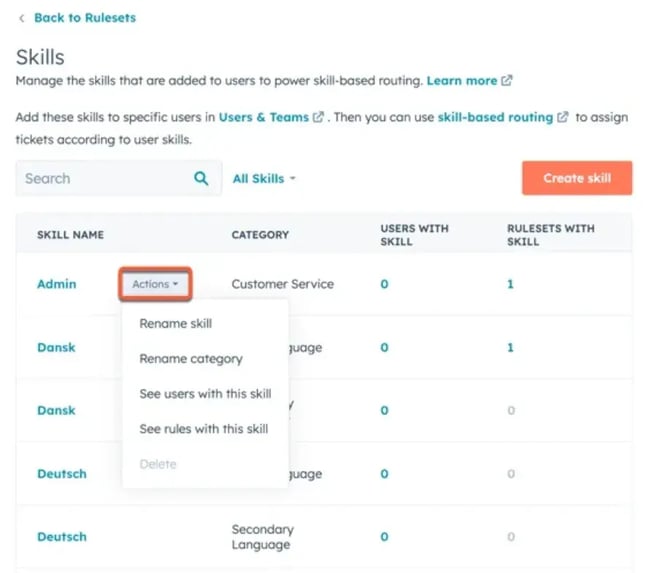
Ticket assignment depends on ticket type, priority, and customer type.
Knowledge Base
HubSpot gives the option to set up a custom knowledge base domain and slug. The best part about maintaining a knowledge base in HubSpot is the analytics to track performance.
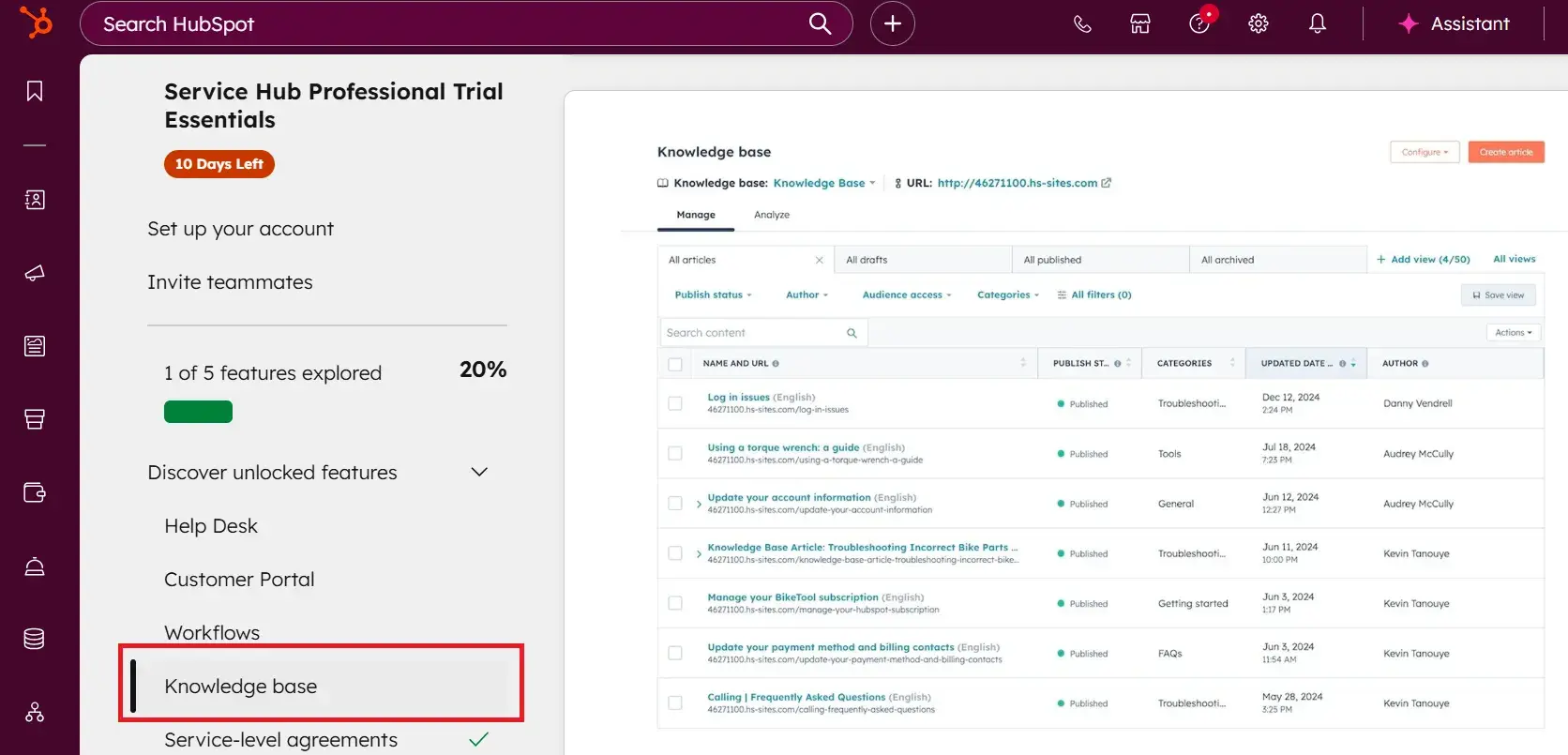
See which articles are most viewed, identify gaps in content, and measure how effectively information resolves customer issues. This helps improve self-service, reduce support tickets, and keep customers informed.
Breeze Customer Agent
Breeze is HubSpot’s AI-powered customer service agent that handles customer conversations efficiently. Breeze can be assigned to chat, email, or messaging apps, or all three of them at once, and be launched in minutes. The obvious advantages of Breeze are quick responses and a better customer experience right away.
Enter your numbers in this calculator, experiment with Breeze, and then determine for yourself if it’s the right fit for you.
SLA Goals
HubSpot lets you define response and resolution times. This assists in managing and meeting customer expectations. It also helps prioritize tickets by setting up SLA goals.
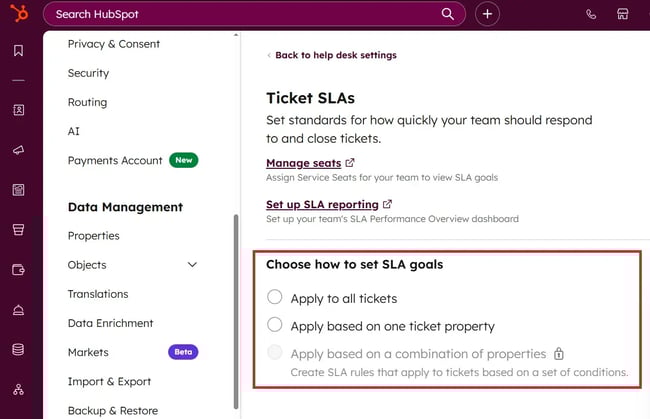
To monitor performance, automated alerts can be set to notify when SLAs are at risk. This keeps teams accountable and ensures continuous improvement in customer service.
Multiple Ticket Pipelines
HubSpot lets you create separate pipelines for different types of issues or teams. Each pipeline can have its own stages, automation, SLAs, and assignment rules. This makes it easy to track processes clearly, avoid confusion, and keep every workflow organized and efficient.
Feedback Management
HubSpot provides the option of creating NPS, CSAT, CES, and other custom surveys.
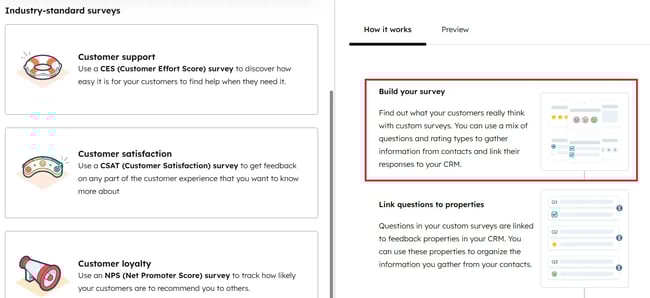
This way, you capture real customer opinions, measure satisfaction at key moments, and spot trends or issues early. The results feed directly into the CRM, making it easier to track sentiment over time and act on feedback quickly.
Pricing:
- Free plan
- Starter $9 per user/month
- Professional $90 per user/month
- Enterprise $150 per user/month
2. Zoho Desk
G2 Review: 4.4 (6,500+ reviews)
Zoho Desk is a customer service tracking tool that centralizes support across multiple channels. Its omnichannel feature lets you manage over 10 communication channels from a single interface, including web forms, social media, instant messaging, and live chat.
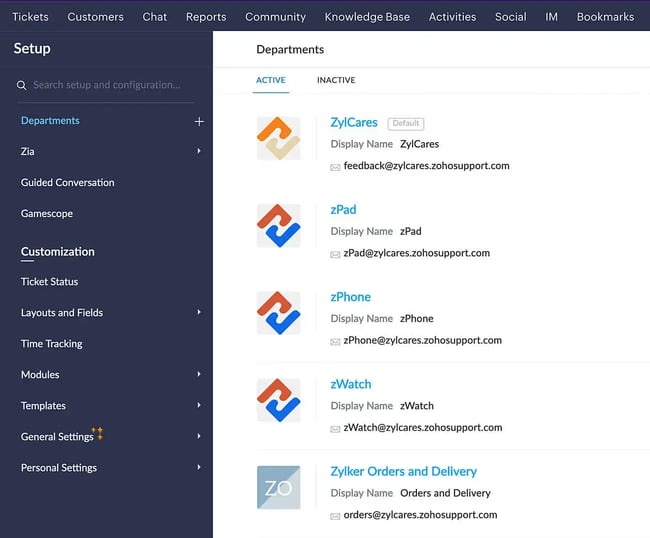
Here are the key features of Zoho Desk worth highlighting:
Integrations
Centralizing customer data inside Zoho is possible as it easily integrates with Slack, Zapier, Google Workspace, and Shopify.
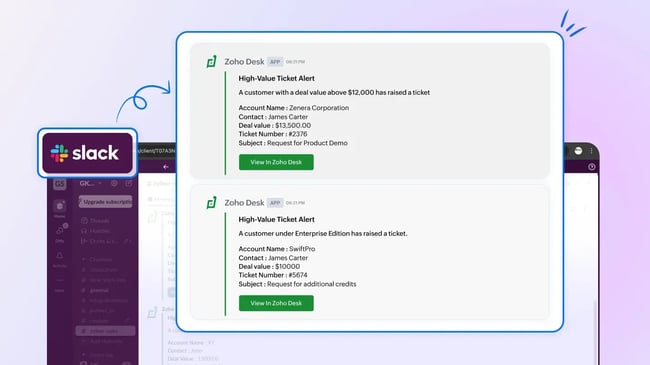
Zoho has a lot of software modules for different purposes. So, additional integrations with CRMs, marketing tools, and ecommerce platforms further enhance collaboration and support productivity.
Ticket Management
Zoho Desk has separate sections for “Agent Queue” and “Team Queue,” which help keep workspaces organized and ensure tasks are clearly assigned. To manage complex requests, it also allows the creation of parent-child tickets to track related issues together.
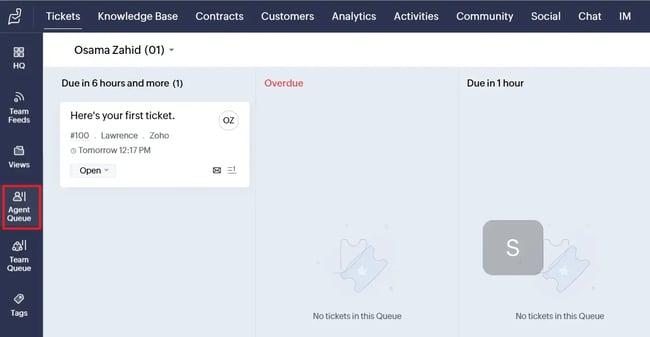
Tickets can also be prioritized, categorized, and automated for routing and escalation.
Workflows
Zia (Zoho’s AI assistant) helps automate help desk operations through intelligent workflows. This feature allows setting up automation rules with predefined actions.
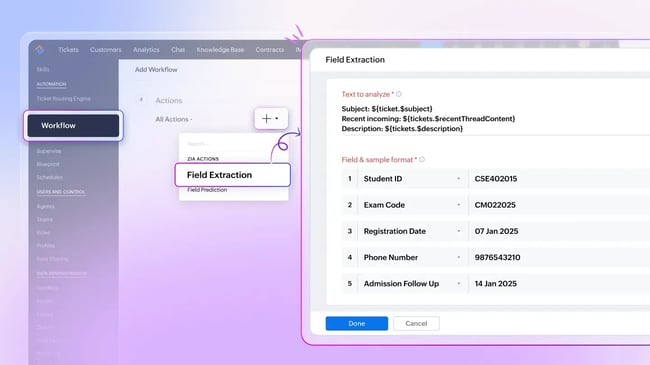
For example, automatically extracting key information from incoming tickets using field extraction.
ZIA – AI Assistant
ZIA helps automate routine support tasks and provides AI-powered suggestions to agents. It recommends the best responses that can be sent to customers.
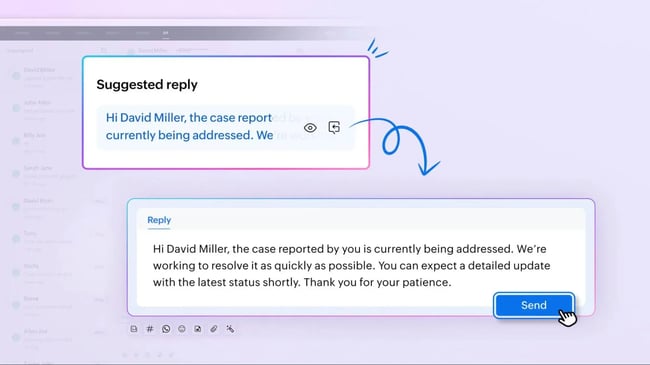
By handling repetitive tasks and offering actionable insights, ZIA improves agent efficiency, reduces response times, and enhances the overall customer experience.
Pricing: $40 per user/month (Professional Plan)
3. Freshdesk
G2 Review: 4.4 (3,500+ reviews)
Freshdesk is an intuitive ticketing system for tracking and prioritizing customer requests, while automation tools route tickets to the right agent and escalate urgent issues automatically.
Some of its most essential features are as follows:
Analytics
Freshdesk provides detailed reports on ticket volume, how fast reps respond, resolution rates, and customer satisfaction.
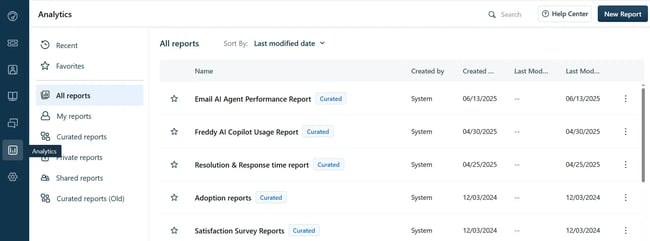
Using reports, you can track trends, identify bottlenecks, and measure how efficiently your support team is operating. Custom dashboards make it easy to monitor key metrics in real-time and make data-driven improvements.
Tickets
Inside the tickets view, you can understand customer requests with a message inbox. Here you can communicate, track, and assign tickets to the right team members for faster resolution.
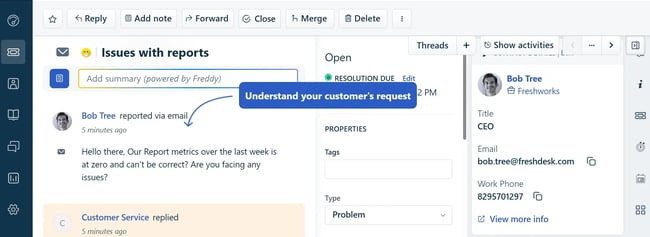
This view gives easy access to the sentiment, priority, status of the tickets, and the essential contact details.
Here, you get a view of all the unresolved, overdue, unassigned, open, and on-hold issues.
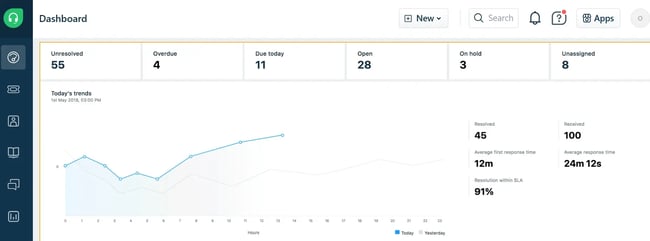
Freshdesk organizes everything in one place so teams can quickly spot priorities, track workload, and take action without missing critical tickets.
Pricing: $108 per user/month (Pro + AI Copilot Plan)
4. Zendesk
G2 Review: 4.3 (6,000+ reviews)
Zendesk is another customer service platform designed to help teams manage support tickets and customer interactions efficiently. It has an uncluttered interface that allows quick access to the primary features. Its clean layout puts tickets, conversations, and customer context front-and-center.
Here are some of its features that stand out:
Intelligent Triage
Intelligent triage is a feature to handle tickets before they’re in the queue.
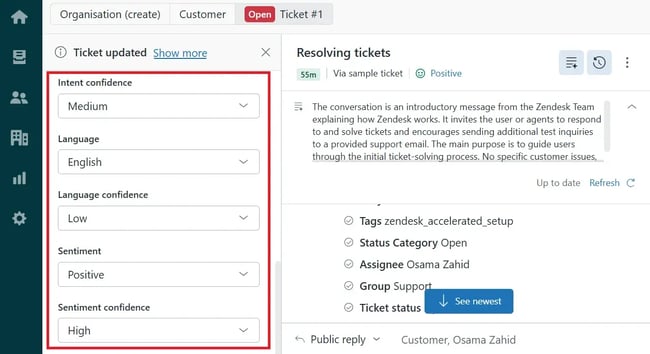
It reads new support tickets and automatically analyzes customer messages by predicting customer intent, sentiment, and language. Easily deflect, route, and prioritize tickets using this feature.
AI Copilot
AI Copilot functionality assists agents by drafting replies, guiding them in between interactions, and providing real-time insights. It also suggests relevant help articles and information from the knowledge base and solves basic tickets autonomously.
Phone Support
Zendesk has also introduced AI agents that handle calls in a human-like voice. It takes actions using the existing workflows and does tasks such as authenticating users by verifying their personal information and solving queries. It redirects to a human agent if there’s a sophisticated case.
Self-Service and Knowledge Base
Zendesk helps companies build self-service portals, help centres, and community forums so that many queries can be resolved without human agents.
Pricing: $151 per user/month (Professional Plan)
Frequently Asked Questions About Customer Service Tracking Software
How does a customer service tracking system integrate with my CRM and existing tools?
Most customer service tracking platforms integrate with teams’ existing CRM systems and other business tools. Integration is possible through APIs, native connectors, or third-party integration platforms such as Zapier or Make. HubSpot offers thousands of integrations through its marketplace.
What’s the safest way to roll out AI without hurting quality?
Start small and pilot first. Begin with limited, low-risk use cases such as routing tickets or summarizing interactions. Then, maintain agent review and approval of AI outputs, especially in complex or sensitive cases. This hybrid model ensures quality control while AI handles repetitive tasks.
How long does implementation usually take?
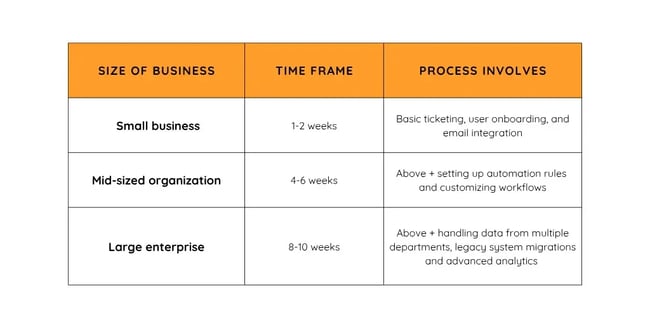
Customer service tracking software implementation can take a few days to a few weeks. Generally, for small businesses, the time frame is one to two weeks (if the setup involves basic ticketing, user onboarding, and email integration).
Here is an implementation timeline according to the size of the business.
Pro tip: A phased rollout (starting with one team or channel, then expanding) shortens deployment time and reduces disruption. With clear processes and proper training, value happens quickly and continues to grow over time.
Will a customer service tracking system help us meet SLAs consistently?
A reliable customer service tracking system helps teams stay compliant with SLA commitments by automatically monitoring every ticket against defined response and resolution timelines. It alerts agents when a ticket is nearing its deadline. This way, urgent cases are prioritized.
Getting Started
Customer service tracking software centralizes customer inquiries, tickets, and communication in one place. It helps your team track issues from start to finish. The basic goal with any customer service tracking software is to streamline support workflows, reduce response time, and maintain consistent service quality.
Must-have features include ticket management, analytics, AI, and omnichannel support to keep service consistent and efficient. Nice-to-have features include customer portal, routing, and advanced integrations that enhance productivity but aren’t essential for daily operations.
The best choice for customer tracking software depends on your team size, support volume, and growth goals. For ecommerce teams, options like Zendesk or Freshdesk work best due to their automation, multichannel support, and order tracking capabilities.
For IT teams, I’d recommend HubSpot Service Hub because it offers advanced ticketing, SLA tracking, and seamless integration with development tools. I’ve personally used HubSpot the most, so I can vouch for the custom automations that make life simpler.
