
A customer portal is a centralized platform that allows users to access product documentation, manage support tickets, and view account information. These portals are not just for the convenience of customers. They directly impact retention, adoption, and satisfaction with the business. 
This guide will walk you through the best customer portal SaaS tools. It will explore key features that reduce churn, compare top tools, and provide actionable use cases for customer success teams.
Table of Contents
- What is a customer portal for SaaS?
- Customer Portal SaaS Features that Actually Improve Retention
- Best Customer Portal Tool for SaaS Teams
- Customer Success Portal Use Cases Across the SaaS Lifecycle
- Q&A: How to Use a Customer Portal Tool to Improve Retention
- Getting Started with Customer Portals
What is a customer portal for SaaS?
A customer portal SaaS is a secure, centralized platform where users can access product documentation, manage support tickets, and view account information, all in one place. Customer portal SaaS provides secure, self-service access to knowledge base, ticketing, and account data.
A customer portal for SaaS generally integrates with CRMs. This integration allows teams to proactively resolve issues, track feature adoption, and personalize outreach. The aim is to turn support interactions into measurable retention opportunities.
CRM-native portals outperform disconnected tools because every login, ticket, or self-service action updates customer records in real time, giving customer success SaaS teams complete visibility into usage patterns, renewal dates, and risk signals. This enables:
- Early detection of churn risk through engagement metrics.
- Personalized outreach and upsell opportunities based on customer behavior.
- Faster issue resolution by automatically surfacing relevant tutorials or knowledge-base articles.
The best client portal software doesn’t just reduce support volume. It builds transparency, trust, and habit. When customers can see their value clearly and resolve problems instantly, they’re more likely to renew, expand, and advocate for your brand.
That brings us to a key decision: Should your team build a custom customer portal or buy a pre-built SaaS solution?
Build vs. Buy a Customer Portal for SaaS
Choosing whether to build or buy your SaaS customer portal is one of the most strategic product decisions a scaling company can make. The right approach depends on your growth stage, technical capacity, and retention goals.
- Build: A custom-built customer portal software for SaaS gives you full control. You can tailor every workflow, integrate deeply with your CRM, and own the entire user experience. However, it demands time, engineering bandwidth, and continuous maintenance.
- Buy: Buying an existing SaaS customer portal solution provides a faster, lower-risk path to value. It provides your support and customer success teams with immediate access to proven features such as Single Sign-On (SSO), ticket visibility, and analytics — without months of development.
Here’s a side-by-side look at the pros and cons of building or buying a customer portal for your SaaS.
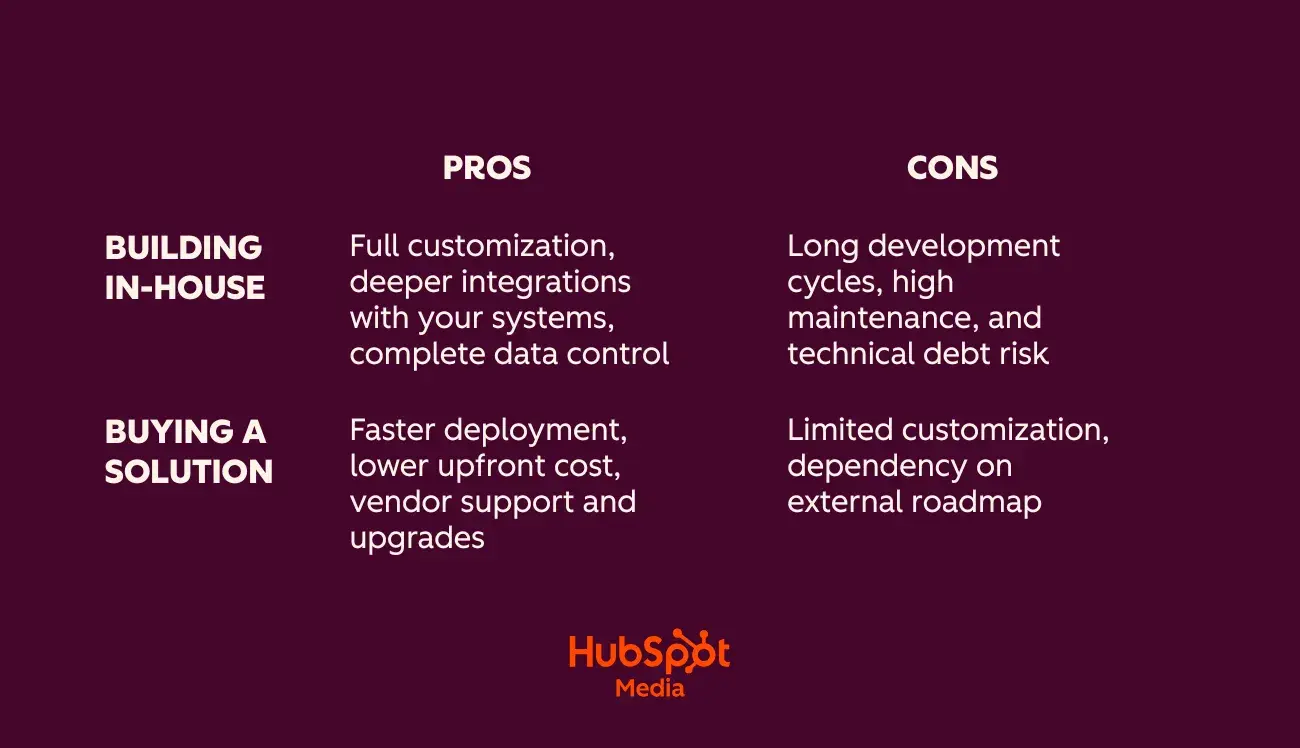
Pro tip: If you’re an early-stage or mid-market SaaS company, buying a customer portal SaaS solution can deliver faster ROI, typically within 60–90 days. For enterprise SaaS providers with complex entitlements or multi-brand needs, building a custom portal would be advantageous if the development team is solid.
Once you’ve decided on your implementation path, the next step is understanding which customer portal features actually move the needle on retention.
Customer Portal SaaS Features that Actually Improve Retention
Not all customer portals improve retention. Only the ones designed to connect customer experience with measurable outcomes do. The best customer portal software for SaaS combines self-service, visibility, and intelligence to reduce churn and build long-term loyalty.
Here are the top eight features that make a customer portal SaaS solution truly effective, ranked by their impact on retention.
1. Analytics and CRM Integration
Tracking portal activity in real-time lets customer success teams spot engagement trends and at-risk accounts. By linking insights directly to your CRM, you can trigger proactive outreach and automated renewal nudges. CRM-native customer portals improve customer retention and satisfaction.
2. Knowledge Base + Federated Search
A central knowledge base with federated search lets users find answers across FAQs, documentation, and community content. Putting all help content in one searchable place lets users solve problems on their own. This lowers support tickets, speeds up onboarding, and helps customers find relevant information.
3. Ticket Visibility and SLA Tracking
Giving customers full visibility into support requests and SLA timelines builds trust. Users feel confident their issues are being addressed, while your team can prioritize urgent cases.
4. Secure Login and SSO
Simplifying access through SSO and role-based permissions ensures users can start using the portal immediately. Faster, secure access increases adoption and allows teams to act quickly on potential problems.
5. Personalized Content and Contextual Guidance
AI is now being used by many up-to-date customer portals. It is proving useful in surfacing relevant tutorials, release notes, renewal notifications, and feature tips tailored to each user’s role, subscription plan, or activity. AI features in customer portals enable ticket deflection and faster resolution, as well. By analyzing usage patterns and engagement signals, AI delivers the right guidance at the right time.
6. Roles and Permissions
Granular access controls ensure that admins, end-users, and billing contacts only see relevant features and data. This reduces confusion, prevents errors, and maintains a clear hierarchy of access.
7. Integrations
Integrations connect the portal to CRMs, marketing tools, and productivity suites. Features from external tools can then be embedded into the portal’s existing workflows.
8. Security
Security features for customer portal SaaS include SSO, RBAC, audit trails, and data boundaries. Encrypted data, password protection, secure file sharing, and detailed access controls ensure customer information is safe. Users can better trust the portal because it will keep sensitive data protected. All of these then combine to reinforce adoption.
Best Customer Portal Tool for SaaS Teams
Here’s how the leading customer portal software options compare at a glance, from all-in-one portals to CRM native portals:
Customer Portal SaaS | Best For | Top Features | Price |
HubSpot Service Hub | Businesses looking to improve retention and benefiting from lifecycle analytics. | – CRM-native portal links activity to engagement metrics. – SaaS customer lifecycle visibility. – Built-in automation for routing, follow-ups, and escalations. | From $100 per user/month |
Zendesk Customer Portal | Mid-sized to enterprise SaaS with established support workflows. | – Self-service knowledge base to reduce ticket volume and friction. – Transparent ticket tracking. | From $25 per agent/month |
Zoho Creator | Small companies looking for bespoke portal workflows, multi-brand, or unique models. | – Custom workflows. – Role-based access. | Enterprise plan at $37 per user/month |
SuiteDash | Growing SaaS companies wanting a cost-effective and all-in-one business platform. | – Bundled portal + CRM enables lifecycle tracking. – Branded client portal experience. | From $99/month (unlimited clients model) |
Clinked | Companies looking for a software that supports integrations and offers functionalities of both project management and customer portals. | – Native integrations with Power BI, DocuSign, and Jotform. – Task management and document management. – Mobile application. | Starting from $119/month and going up to $599/month |
HubSpot Service Hub
Best for: SaaS companies already using HubSpot’s Smart CRM (or considering it) that want a customer portal SaaS solution tightly integrated with lifecycle and retention analytics.
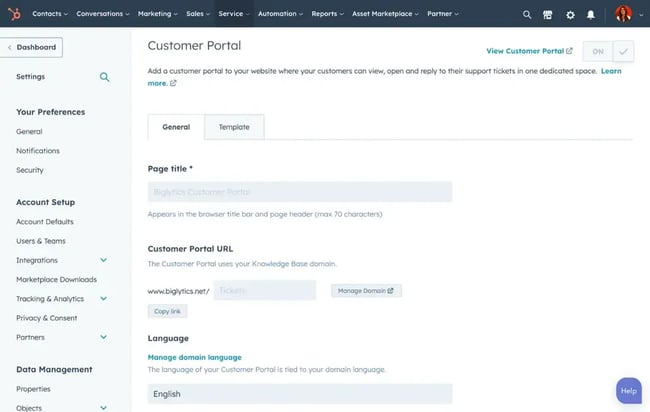
HubSpot Service Hub offers a CRM-native customer portal with a knowledge base, ticketing, and AI integration. Service Hub connects customer portal activity directly to its CRM. SaaS teams can see how customers use the portal, spot early churn signals, and personalize follow-ups.
Everything runs on the same data platform. This turns self-service, ticket tracking, and customer-lifecycle visibility into retention tools — not just support features. Because of that connection, any activity inside the portal can be tracked as CRM data.
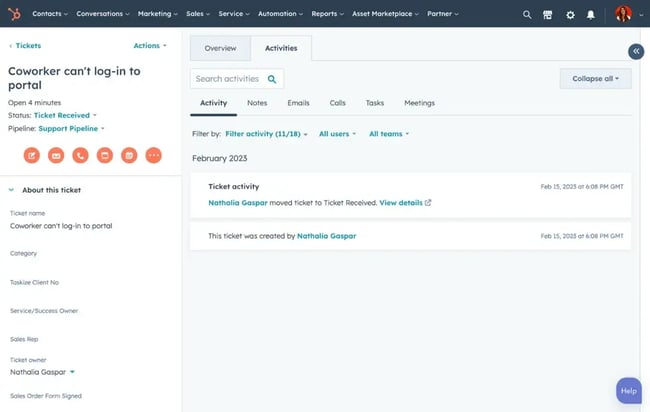
That data can then be used to measure engagement (how often customers interact, what they view, what they request) and retention signals (like satisfaction, activity drop-offs, or renewal intent).
With these insights, teams can intervene proactively. For example, reaching out if a customer hasn’t logged in for a while or offering help if a ticket stays unresolved.
Most Useful Features
- AI: HubSpot’s Breeze, an AI customer service agent, can be trained swiftly using your company’s existing content.
- Meeting scheduling: Customers can view shareable links to book meetings with the team easily and avoid the usual back-and-forth via email.
- Health score: The ability to evaluate customer relationships using key data points, reports, and automated insights.
- Ticket pipelines: Split tickets into different pipelines, for example, by region, brands, or teams. Manage each one uniquely to suit your business processes.
- Calling: Users can dial and receive calls directly, record, and automatically log them in your database. A HubSpot-issued phone number is required for inbound calls.
- Omnichannel support: With HubSpot’s omnichannel customer service, you meet clients everywhere and provide them easy access to your team.
- Help Desk Software: Delivers personalized, AI-powered support with a complete view of every customer interaction, saving time and reducing errors with intelligent automation and seamless CRM integration.
Pros:
- CRM‑native, seamless integration with service + marketing/sales data.
- Affordable entry pricing for smaller teams.
- Ability to track form submissions, support requests, and document downloads as CRM data.
- Native integration with knowledge base, chat, calling, and inbox tools.
- Secure, branded portal experience without hiring an external development team.
Cons:
- Advanced portal features such as conditional SLAs and skill-based routing require purchasing a higher tier.
G2 Rating: 4.4/5 with 2,000+ reviews.
Pricing: Starting price is $10 per user/month, scaling up to $150 per user/month.
Zendesk Customer Portal
Best for: Mid‑sized to enterprise SaaS companies with established support workflows looking for a scalable portal that centralizes engagement and reduces churn.
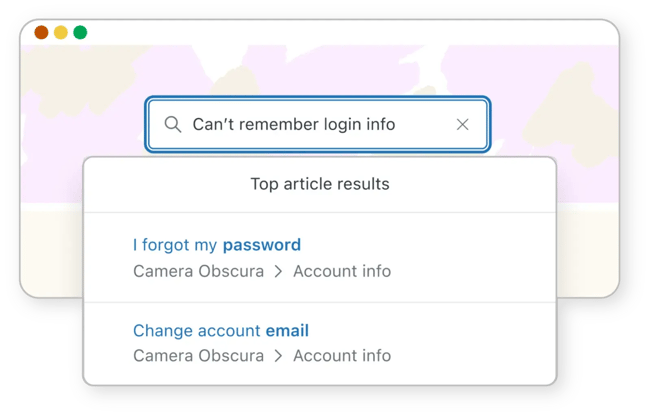
Zendesk’s portal combines self-service, AI-powered knowledge suggestions, ticket visibility, and role-based access. AI recommends relevant articles to users before they submit a ticket, reducing support volume and accelerating resolution.
Zendesk allows analytics to be integrated with your CRM to highlight at-risk accounts. So, your team can proactively intervene.
Zendesk’s features (such as advanced AI agent builder, Copilot, and advanced AI reporting and reasoning controls) are additional paid add-ons.
Pros:
- Mature ecosystem of integrations.
- Strong self‑service capabilities.
- Enterprise‑grade security.
Cons:
- Potentially high per‑agent pricing for large teams.
- Customization/configuration requires a significant investment.
G2 Rating: 4.3/5 with 6,000+ reviews.
Pricing: Plans start around $25 per agent/month, with advanced tiers ($69–$219 per agent/month) for enterprise‑grade features.
Zoho Creator Customer Portal
Best for: SaaS companies needing a bespoke portal that supports a branded experience and the ability to create custom workflows.
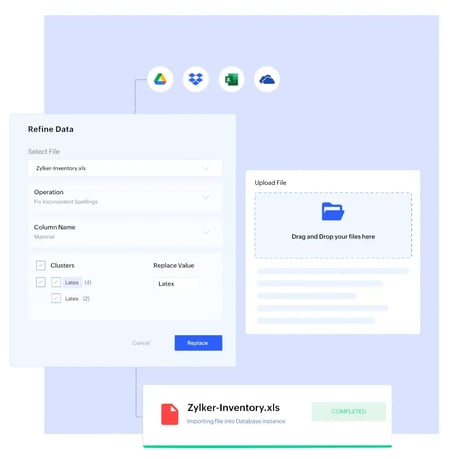
Zoho Creator’s customer portal enables SaaS teams to build highly customizable, branded portals with access control, workflow support, and integration with internal systems. It isn’t just for building client portals. It also lets you create fully customized mobile applications.
Pros:
- Flexible customization.
- Supports specialized workflows and branded experiences.
- Cost‑effective entry.
Cons:
- Requires more implementation effort.
- Does not have plug-and-play portal features (knowledge base, SLA tracking).
G2 Rating: 4.3/5 with 150+ reviews.
Pricing: Enterprise plan at $37 per user/month
SuiteDash
Best for: Small to growing SaaS companies that want a cost‑efficient portal with the CRM bundle, particularly where retention comes from strong lifecycle engagement rather than large enterprise complexity.
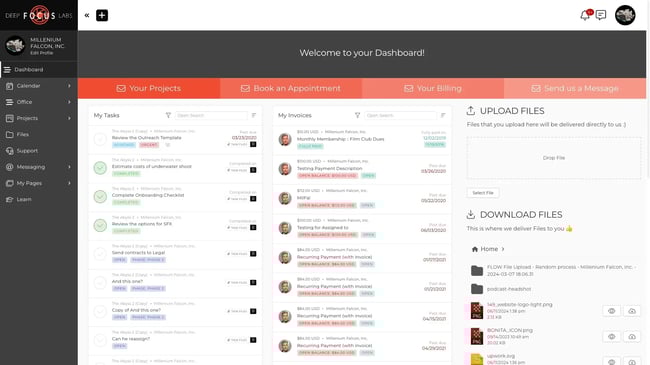
SuiteDash offers a bundled portal + CRM + client management platform. It is a strong choice for SaaS companies that would benefit from unlimited team access. It also provides a hub for support, usage visibility, and account insights.
Pros:
- Fixed pricing with unlimited clients/team members.
- Integrates portal + CRM in one platform.
- Cost-effective for growth.
Cons:
- Generalist tool, not as specialized as some dedicated portals.
- Fewer integrations and may require more custom setup for SaaS-specific use cases.
G2 Rating: 4.8/5 with 500+ reviews.
Pricing: $99/month for all features and unlimited team access.
Clinked
Best for: Companies that want one platform for both project management and customer portals and that rely heavily on integrations in their workflow.
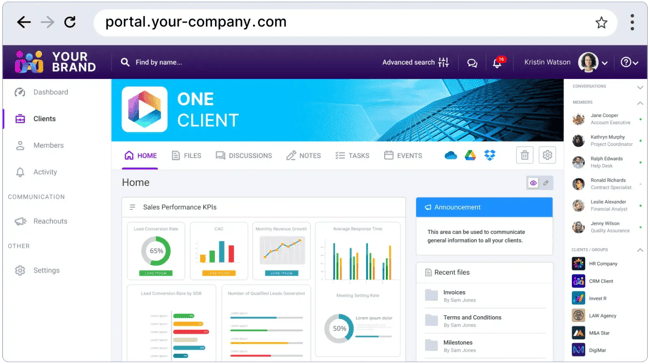
Clinked strengthens client relationships with its secure customer portal. It supports seamless communication, organized document sharing, and helps teams manage client work efficiently.
In addition to offering all core functions of a client-portal system, it offers project management features.
Pros:
- Supports a lot of integrations.
- A mobile application that allows communication with customers on the go.
Cons:
- The pricing is high.
- SSO option and Dropbox migration are only available in the Enterprise plan.
G2 Rating: 4.9/5 with 300+ reviews.
Pricing: The standard package is billed at $299/month, with the premium package going up to $599/month.
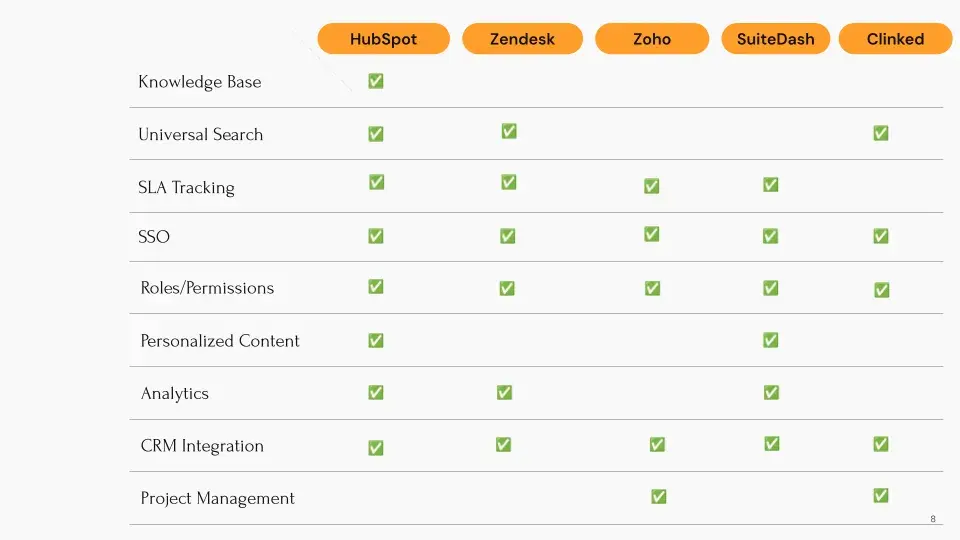
Let’s do a quick comparison of the features that exist in each of the tools mentioned above:
Customer Success Portal Use Cases Across the SaaS Lifecycle
SaaS teams make use of client portals differently throughout the customer lifecycle. These use cases show how customer portals can be used by companies to boost adoption, engagement, and renewals.
Guided Onboarding Plans
Early engagement sets the tone for long-term retention. Customer success teams use portals to create step-by-step onboarding checklists with tutorials, tasks, and milestones.
Integrated features like knowledge-base articles, dashboards, and progress tracking ensure new users complete critical actions quickly. Structured onboarding helps users see value faster and reduces early churn.
Feature Adoption Checklists and Contextual Guidance
After onboarding, customers may underuse key features. Portals allow teams to deliver personalized adoption guides and contextual tips based on a user’s role, subscription tier, or activity. By using content recommendations, teams can surface underutilized features before disengagement occurs.
Transparent Incident Handling and SLA Tracking
It is natural for a customer to feel frustrated if they are uncertain about the outcome of their support requests. Portals provide ticket visibility, SLA timelines, and suggested knowledge articles, reducing back-and-forth communication. With role-based permissions, users see only relevant tickets.
Release Notes and Product Updates
Keeping customers informed about updates is critical for ongoing adoption. Teams can publish release notes and product tips in the portal. Specific users can also be targeted with relevant notifications.
Personalized dashboards and content recommendations ensure updates are seen and acted upon. The goal is to use these portals for proactive communication to keep users engaged.
Customer Account Health Insights
Portals can act as customer health monitoring tools. Customer service and support teams can identify at-risk accounts and guide them before issues arise. Combining analytics and CRM integration reinforces stickiness and empowers teams to act before they churn.
Q&A: How to Use a Customer Portal Tool to Improve Retention
1. What’s the difference between a customer portal and a client portal?
While “customer portal” and “client portal” are sometimes used interchangeably, the main difference lies in who they serve and what they prioritize: Customer portals focus on self-service for end-users, whereas client portals focus on collaboration and project management for business clients.
Customer Portal
- Best for end-users of a SaaS product, including individual subscribers or employees within an organization.
- Good for self-service tasks like managing subscriptions, viewing usage data, or submitting support requests.
Examples of how a customer portal SaaS would be used:
- Checking feature access or plan details.
- Accessing a knowledge base to solve common issues.
- Reviewing billing history or invoices.
A customer portal SaaS provides users control and instant answers, reducing frustration, boosting adoption, and increasing renewal likelihood.
Client Portal
- Best for organizations or clients with ongoing service agreements or project-based work.
- Good for collaboration, secure communication, and project tracking.
Examples of how a client portal would be used:
- Sharing and approving proposals or contracts.
- Tracking project milestones with a consulting team.
- Coordinating tasks and exchanging sensitive documents.
A client portal strengthens engagement with high-value clients, improving satisfaction and increasing the chance of contract renewals or expansions.
2. Can I use my CRM login to authenticate the portal?
In most cases, yes — many SaaS customer portals can be configured to use your existing CRM login for authentication. If your CRM supports Single Sign-On (SSO) or has an identity provider integration (like OAuth, SAML, or OpenID Connect), you can connect it to your portal so users log in with the same credentials they already use. This creates a seamless experience, reduces password fatigue, and maintains consistent access control across systems.
However, whether this works out of the box depends on your CRM and the portal platform you’re using. Some portals offer direct CRM authentication integrations, while others may require middleware or custom development to bridge the two. If you’re using HubSpot, for example, its CRM supports private content and membership features, but you may need to align your portal’s auth setup with HubSpot’s user or contact-based permissions.
3. How long does it take to launch a customer portal?
Launching a customer portal can typically take anywhere from 2 to 4 weeks. The time may vary depending on whether you’re using a vendor-provided solution or building a custom portal in-house. Custom-built portals require at least 2–3 months for development, CRM integration, and quality testing.
Understanding these timelines helps teams plan onboarding, adoption, and integration strategies to ensure customers start deriving value quickly.
Why timelines for launching a customer portal SaaS can vary:
- Type of portal. Vendor SaaS portals come pre-built with standard features, while custom-built portals require development from scratch.
- Complexity of features. Portals with advanced content analytics or multi-brand support take longer to configure.
- CRM integration level. Full integration with Salesforce, HubSpot, or Zendesk can add setup time.
Factors that influence launch timelines for a customer portal:
- User testing and feedback cycles. Iterating on admin dashboards or end-user workflows can extend the launch.
- Data migration needs. Moving historical support tickets, usage data, or knowledge base content into the portal may take extra time.
- Branding and white-labeling. Custom domains, logos, and role-specific dashboards require additional configuration.
- Internal approvals and workflows. Sign-offs from product, support, and operations teams can impact the rollout schedule.
A faster launch of the customer portal accelerates self-service adoption, reduces early churn, and provides actionable usage data for proactive customer success interventions.
4. How do I measure success after launch?
Measure success after launching a customer portal SaaS solution by tracking engagement and key metrics such as portal logins, feature usage, article views, and ticket deflection rates. Customer satisfaction (CSAT), Net Promoter Score (NPS), and qualitative feedback also provide insights into how well the portal meets user needs.
KPIs to track success and their methodologies:
- User Adoption Rate. Percentage of customers actively using the portal and reducing support dependency.
Measurement methodology: Track login analytics, daily/monthly active users (DAU/MAU), and feature interactions.
- Ticket Deflection Rate. Percentage of support issues resolved via self-service without creating a ticket.
Measurement methodology: Measure self-serve interactions and divide them by the total help-seeking attempts (knowledge base article views, FAQ searches).
- CSAT / NPS: Customer satisfaction and loyalty scores.
Measurement methodology: Collect survey responses post-interaction to assess satisfaction with the portal experience.
Connect each KPI to customer engagement and satisfaction. Intervene proactively when something is not working. And then determine if the client portal is successful.
5. Can I brand and white‑label the portal?
Yes! Many customer portal SaaS solutions allow full branding and white-labeling to align the portal with your brand identity. So, you get to use your own logos, color schemes, and design layout.
Familiar, consistent branding builds trust, improves user engagement, and encourages frequent portal usage. This results in higher renewal and upgrade rates.
Here’s how you can brand and white label a customer portal SaaS:
- Custom Logos and Colors
Apply your company’s logo, primary colors, and fonts throughout the portal interface. This can help reinforce brand recognition, build trust, and create a consistent experience for users. - Custom Domains and URLs
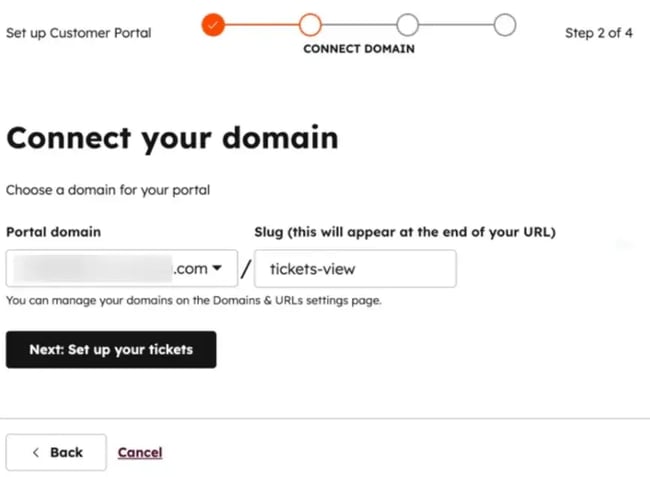
Use a custom domain for your portal. This will make the portal feel like a native part of your product ecosystem.
- Tailored Content and Guides
Offer tutorials, release notes, or onboarding materials that reflect your branding and messaging.
Getting Started with Customer Portals
A customer portal SaaS is more than a support tool; it’s a strategic retention lever. By integrating the knowledge base, ticketing, and account context, it helps translate features into tangible business results.
CRM-native portals make adoption and renewals even simpler. A tool like HubSpot’s Service Hub with a built-in customer portal and software ecosystem connects portal activity directly to engagement and retention metrics. This helps teams take early action to keep customers happy.
Intuitive tools with clean navigation and dashboards encourage frequent use. This way, users can accomplish tasks efficiently, making the portal a go-to resource rather than a chore.
